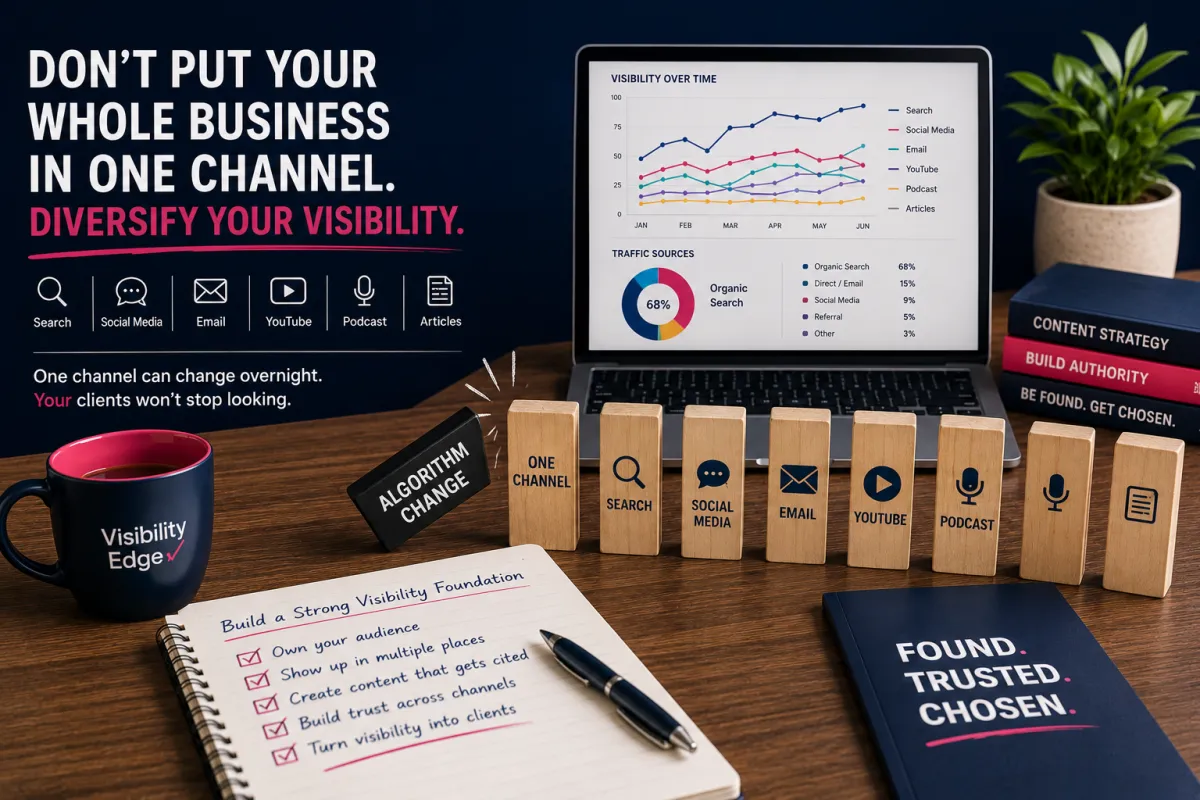
Why One Traffic Source Is Putting Your Whole Business at Risk
You post consistently. You show up on the one platform that's worked before. Then one day, the numbers just stop coming in, and you have no idea why.
Key Takeaways
Relying on a single platform for your visibility isn't just risky. It puts your whole business one algorithm update away from a quiet inbox.
Rising ad costs mean paid traffic alone can't carry your growth the way it used to.
Tracking exactly which channel brought you a client is harder than ever, so betting everything on one channel means flying blind.
AI tools like ChatGPT and Google's AI Overviews now answer questions directly, which means your visibility needs to exist in more than one place to get cited at all.
One strong piece of content, reshaped for a few different platforms, beats a dozen rushed posts spread across just one.
The Risk of Renting Your Visibility
Here's an uncomfortable truth. If your business depends on one platform, whether that's Instagram, a single ad account, or referrals alone, you don't actually own your visibility. You're renting it.
And landlords change the rules. Algorithms shift. Reach drops overnight for reasons no one explains to you. A platform update can quietly cut off the exact channel that used to bring you clients, and there's nothing you can do about it but wait.
This isn't about panic. It's about knowing where your risk actually sits, and building something sturdier underneath it.
Paid Ads Alone Won't Carry You Anymore
If you've leaned on ads to bring in leads, you've probably felt the squeeze already. Ad costs have been climbing for a while now, and AI-driven bidding has made the easy, cheap click much harder to find.
That doesn't mean ads are dead. It means they work best as a boost, not a foundation. Pour ad spend into content that's already proving itself organically, and you get a lot more for your money than starting cold with an ad campaign alone.
Without something organic underneath your paid traffic, your growth stays capped by what you're willing to spend every single month.
The Old Way of Tracking Clients Doesn't Work Anymore
Here's something that trips up a lot of coaches and consultants. You assume you know where your clients come from, because you can see the one channel that referred them last. But that's rarely the full story.
Someone might see your name on LinkedIn, get forwarded a newsletter from a friend, then finally book a call after a Google search weeks later. If you're only watching one channel, you miss the whole path that got them there.
Tracking has also gotten trickier. Safari and Firefox already block a lot of cross-site tracking by default, and Chrome's approach keeps shifting too. None of that means tracking has vanished. It means it's a lot less reliable than it used to be, and last-click credit tells you less than it once did.
The fix isn't a fancier tracking tool. It's showing up in more than one place, so you're not depending on a single, shaky signal to know what's working.
Google Isn't the Only Front Door Anymore
The old idea that ranking on Google is the whole game is already out of date.
Search itself has changed. Google's AI Overviews and AI Mode, along with tools like Perplexity and ChatGPT Search, often answer a question directly, with no click required. People are also searching by voice and by typing a question straight into a chat window, not just plugging in a string of keywords.
Here's the part that matters most for you. Getting cited inside one of those AI answers isn't just about ranking well. It's about having enough content, in enough places, that AI tools can piece together a clear, consistent picture of who you are and what you know. One lonely blog post on one platform gives an AI model very little to go on. A body of work spread across a few trusted formats gives it a lot more.
This is the found, trusted, chosen shift in action. Being found by an AI tool means nothing if what it finds doesn't back up your expertise. And it can't back you up if it only sees you in one place.
You Don't Need to Create More. You Need to Repurpose Smarter
If you've been telling yourself you need to post every single day to stay visible, here's some relief: that's not actually true.
A better approach is what we call Pillar and Particle. Instead of creating ten separate pieces of content for ten platforms, you create one strong "pillar," a deep-dive video, an article, a real case study, and then reshape it into smaller "particles" for the places your audience already spends time. That might mean a couple of short videos, a longer article built for AI citation, a newsletter, and a few social posts drawn from the same core idea.
One well-made, expert-level piece of content, shared across a few places, will outperform twenty rushed posts crammed onto a single platform. Depth wins over sheer frequency, every time.
Where to Put Your Energy First
Not every channel deserves equal attention. Here's a simple way to think about priority:
Start with what you own. Your email list and any direct way to reach your audience can't be taken from you by an algorithm change. This is your safety net.
Add one discovery channel. Pick one place, like LinkedIn or short-form video, where new people can find you without ad spend. This is how strangers become future clients.
Build for AI visibility. Structure your content so AI tools can find it, understand it, and cite you as the expert. This is what turns "found" into "trusted."
Use paid ads to amplify, not to launch. Spend on what's already working organically, instead of hoping an ad alone can carry a brand-new offer.
The Bottom Line
Relying on one channel isn't a shortcut. It's a slow leak in a business you've worked hard to build.
You don't need to be everywhere at once, and you don't need to create more content than you already do. You need your best work showing up in the handful of places your ideal clients, and the AI tools they're starting to ask, actually look.
That's not more work. It's the same work, built to hold.
→ Not sure where your visibility gaps actually are? Book your free Visibility Edge Authority Visibility Audit: www.audit.visibilityedge.com
