How Your Buyers Actually Think Before They Buy
Keyword tools tell you what people type. They don't tell you what's actually running through a buyer's mind before they ever open a search bar. Here's the gap most content marketing misses, and how to close it now that AI search is part of the picture.
Key Takeaways
Most content answers what buyers type into Google, not what's actually on their mind before they search.
In 2026, about 68% of Google searches end without a click, and that climbs to over 80% when an AI Overview shows up. If your content isn't cited there, your buyer never sees you.
Buyers move through three mental stages before they spend a dollar: aware, comparing, deciding. Most content only targets one.
The fix isn't more posts. It's mapping content to how buyers actually think at each stage, and structuring it so AI search tools can cite you by name.
Businesses winning right now write for the person reading and the AI reading at the same time.
Why Doesn't My Content Convert, Even When Traffic Looks Fine?
Think about the last blog post you read that made you buy something. If you can't remember one, you're not alone. Most readers can't either.
That's the exact wall every business owner hits. You spend hours writing a post, publish it, and traffic trickles in. The numbers look fine on a dashboard, but the phone stays quiet.
Buyers don't think in keywords. They think in problems, doubts, and comparisons, and they've usually had three or four of those mental conversations with themselves before they type anything. If your content only meets them at one point in that conversation, you've already lost most of them.
What Are Buyers Actually Thinking Before They Search?
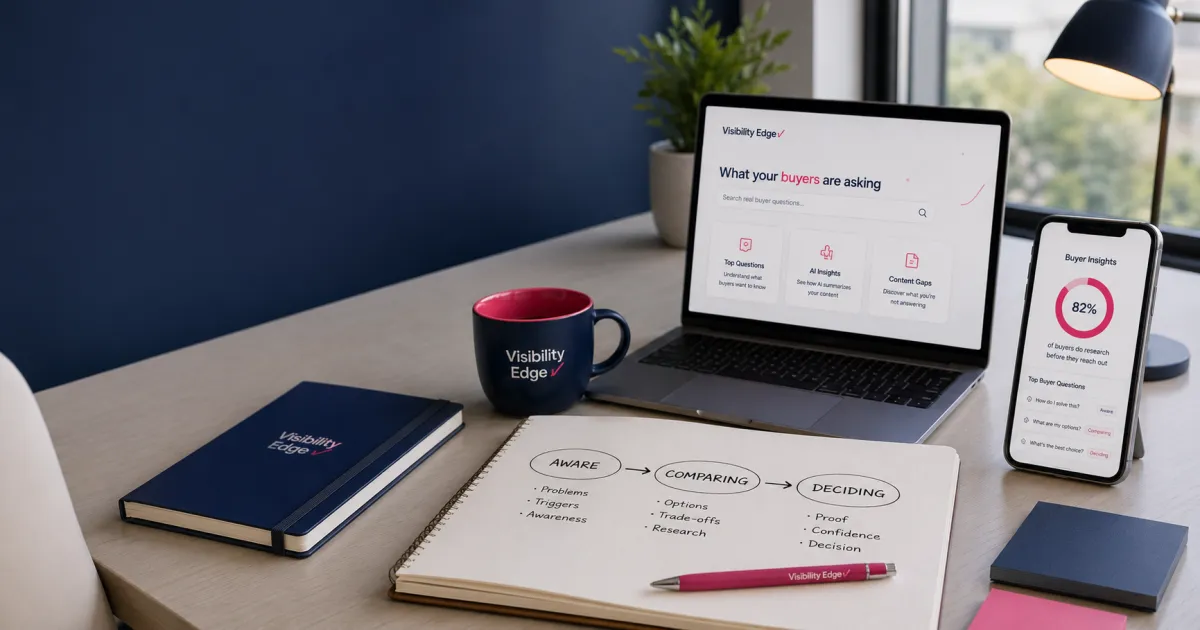
A buyer's mind moves through three rough stages before they're ready to spend anything. Most content marketing only writes for the last one.
Stage 1 — Aware. Something feels off, but they can't quite name it yet. They ask vague questions like "why isn't my marketing working" or "how do small businesses get found online now."
Stage 2 — Comparing. They've named the problem and started scoping solutions. Their questions get sharper: "content marketing vs. paid ads, which is better for a small business" or "is SEO still worth it."
Stage 3 — Deciding. They've shortlisted and now want proof. They search for specific comparisons and reviews, ready to choose.
Most content marketers write only for Stage 3, or worse, chase keyword volume, which usually just surfaces Stage 1 noise. That produces posts that attract browsers and miss the people actually ready to buy.
What Is the Buyer Journey Map, and Why Does It Need a Third Circle Now?
The original Buyer Journey Map used three overlapping circles: verified demand, manageable competition, and buyer intent. The sweet spot in the middle was content built to rank and convert. Andy Crestodina's research at Orbit Media has backed this model for over a decade, including the finding that blog posts built around subject-matter expert input are almost twice as likely to deliver strong results (Orbit Media Blogging Statistics).
That map still holds up. It just needs a third circle for how people search now.
At Visibility Edge, we map content against verified demand (the real questions buyers ask across Google, YouTube, Reddit, LinkedIn, and inside AI tools), buyer intent (questions tied to an actual purchase decision, not idle browsing), and AI citation potential (whether the content is structured clearly enough for ChatGPT, Perplexity, and Google AI Overviews to pull from it and credit you by name). Where all three overlap is where content earns its production cost back. Everything outside that circle is decoration.
Why Did My Content Traffic Get Quieter in 2026?
Two shifts collided at once. Search stopped sending clicks, and AI tools changed how people research before they buy.
On the first shift, SparkToro's most recent research found roughly 68% of US Google searches now end without a click, and that number climbs to over 80% on searches that trigger an AI Overview (SparkToro, 2026). Open-web traffic has dropped roughly 46% over the last three years as a result (PPC Land / Datos & SparkToro Q1 2026 report).
On the second, AI Overviews now show up on roughly half of all Google searches, and Perplexity typically pulls five to ten candidate pages per query but only cites three or four of them (Profound, AI Platform Citation Patterns). ChatGPT leans hardest on a small handful of trusted sources: Wikipedia alone accounts for roughly 8% of all its citations, and a small business site without strong outside signals barely registers. Keyword research was always a stand-in for buyer intent, not the real thing, and in 2026 that stand-in has gotten a lot weaker.
How Do I Get My Content Cited by AI Search Instead of Scrolled Past?
Three moves actually shift this.
Map the questions buyers ask, not the keywords they type. Find out where your buyers are really researching, and what words they use to describe the problem to themselves, even the version they'd only type into ChatGPT. Keyword tools come in later, as confirmation, not as your starting point.
Build content AI tools can actually extract. That means answer-first structure, clear definitions, cited sources, and short, direct sentences. This is what people now call Answer Engine Optimization, and it's the difference between getting cited and getting scrolled past.
Build consistent authority across the places AI models already trust. AI tools look for agreement across sources. If your name shows up saying similar things across your site, industry publications, podcasts, and review sites, AI tools learn to recommend you. If you only exist on your own site, they'll recommend whoever has the wider footprint instead.
Where Does This Leave You?
The prospect asking ChatGPT for an expert in your field right now isn't looking at your latest blog post. They're looking at whatever AI cites back to them.
If that's you, you get the call. If it's a competitor, you never even knew that prospect was shopping.
That's the invisible expert problem, and it's almost always fixable once you know exactly where your content is missing buyers at each stage of how they actually think.
Claim your free Authority Visibility Audit and find out which buyer questions you're winning, which ones a competitor is winning instead, and where the gaps are quietly costing you sales.
