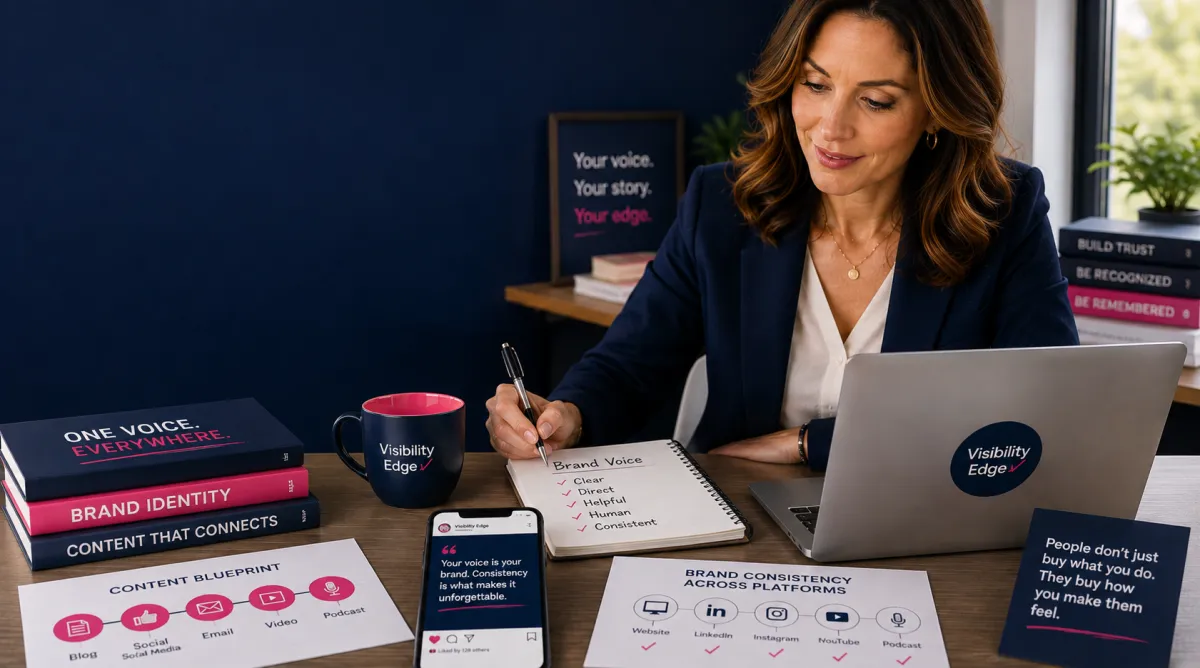
Branding Your Content So It Actually Sounds Like You
You could post every day for a year, and if none of it sounds like you, it won't build anything. Consistent content and branded content aren't the same thing. One fills a feed. The other makes people recognize you before they even see your name.
Here's what branding your content really takes, and how to do it without losing your voice in the process.
Key Takeaways
Content branding is consistency, not just a logo or a color palette.
You can't brand content for an audience you haven't actually defined.
Your brand voice should stay steady. Your tone can flex by platform.
AI search tools now treat your brand as an entity, and voice consistency is one of the signals they use to recognize it.
Consistent branding shows up in real revenue, not just recognition.
What Is Content Branding, and Why Does It Matter?
Content branding is weaving your brand's identity into everything you create, so people recognize it's you before they see your name. It's more than a logo or your brand colors on a graphic. It's a consistent experience that reflects your values, your personality, and what you actually stand for.
Consistency is what makes it work. When your audience knows what to expect from you, they engage more and trust you faster. That trust is what turns a follower into a client.
It also matters more than it used to. Attention is harder to earn than it ever was, and a recognizable voice is one of the few things a competitor can't copy.
Consistency pays off in real numbers too: brands that stick to it report revenue growth of 10-20% (Lucidpress, State of Brand Consistency report). Branding isn't decoration. It's what makes you memorable enough to get chosen.
Who Is My Audience, and How Do I Actually Reach Them?
You reach them by knowing more than their age and job title. You need their real pain points, in their own words, before you can write anything that lands. Skip this step, and your branding efforts fall flat no matter how polished they look.
Start with real research. Surveys and direct conversations get you honest feedback. Social listening shows you what your audience is already saying, in their own language. Analytics tools like Google Analytics can round out the picture with real behavior data.
Turn what you learn into a clear picture of who you're writing for: their goals, their frustrations, what's already failed for them. If they're skeptical of generic AI content, for example, that's worth naming directly in your content, not glossing over. When your content mirrors your reader's actual situation, it feels personal instead of generic, and that's what earns trust.
What Is a Brand Voice, and How Do I Build One That Sounds Like Me?
Your brand voice is the personality behind your words: how you sound no matter what you're writing. Your tone can shift by platform, but your voice underneath it should stay the same.
To find yours, start with what you actually believe and how you actually talk. Are you direct and no-nonsense, or warm and reflective? Your voice should match who you are, not who you think you're supposed to be online.
A therapist-turned-coach and a business strategist shouldn't sound the same, even if they're writing about the same topic.
This is exactly where many experts get stuck. You've tried generic AI prompts before, maybe a stack of prompt packs, and the output came back sounding like everyone else's content, not yours. That's not a personal failure. Generic tools without your real material to draw from will always default to generic language.
The fix is documenting your voice, not avoiding AI-assisted writing altogether. Once your voice is mapped from your own words, and a real person reviews every piece before it ships, AI-assisted content can sound like you again.
Write it down in a simple style guide: preferred words, phrases you'd never use, and a few real examples. That guide is what keeps your voice consistent even as your content volume grows.
How Do I Keep My Visuals and Style Guide Consistent?
Consistency comes from documenting your choices once, then reusing them everywhere. Define your color palette, your typography, and how your logo should appear before you need it for the tenth piece of content.
Build simple templates for the content you create most: social posts, blog headers, email graphics. Tools like Canva make this manageable even without a design background, and a documented style guide (voice, tone, formatting rules, visual guidelines) means anyone helping you, whether that's a freelancer or a full team, produces something that still looks and sounds like you.
Why Does Storytelling Matter for My Brand?
Stories make your brand memorable in a way facts alone can't. They give your audience a reason to care and a reason to remember you specifically.
Share your own path: why you started this work, a real client result, a moment that shaped how you practice. A coach who once felt invisible online, then built a real system for getting found, has a story that resonates directly with someone in that same spot right now.
Structure it simply: where things stood, what changed, where things are now. Real stories build the kind of trust that converts a reader into a client, not just a subscriber.
How Do I Optimize for SEO and AI Search Without Losing My Voice?
You do it by writing for your reader first, then structuring for search. AI-assisted keyword research still helps you find what your audience is actually searching for, but the words need to fit how you'd actually say them, not just what ranks.
AI search tools increasingly treat brands as entities, not just strings of keywords — voice consistency is one of the signals they use to tell you apart from everyone else in your field. This is an emerging pattern across 2026 AI-search research; we haven't found one definitive study to cite, so treat it as a directional trend, not a hard number.
That means the same voice-first approach that builds trust with readers also helps you get found and cited by AI tools like ChatGPT and Perplexity. Optimizing for search and staying true to your voice aren't in conflict — done right, they're the same work.
How Do I Know If My Branding Is Actually Working?
Track engagement, but also track brand recall: do people remember your content came from you specifically, even without seeing your name attached? Conversions matter too, but they're the lagging indicator, not the leading one.
Google Analytics and platform-native insights will show you the patterns. If a specific voice, format, or topic consistently performs, do more of it. If something isn't landing, look at whether it actually sounds like you before you assume the topic was wrong.
Ready to Make Your Content Sound Like You, Everywhere It Shows Up?
Branding isn't a one-time project. It's the thread that runs through every post, every platform, every piece someone finds you through, whether that's Google, social, or an AI assistant answering a question about your field. The businesses that get chosen aren't the loudest. They're the ones who show up sounding like the same real person, every time.
If you're not sure whether your current content actually sounds like you, or whether it's built to be found at all, take the Authority Visibility Audit and get a clear look at what's working and what's not.
